
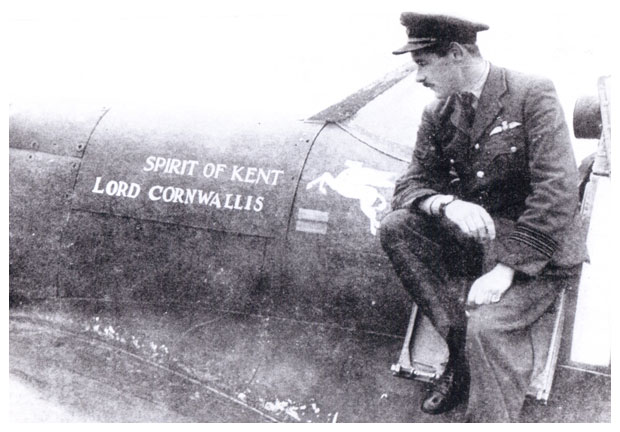
Kent and the Spitfire are synonymous with each other for two reasons. The first is that together with the Hawker Hurricane it fought the Battle of Britain in the skies above Kent. The second is that the good people of Kent donated money from 1941 onwards to purchase a squadron of Spitfires.
This ‘gift of war’ came about due to the unfortunate luck of Wg Cdr Robert Stanford Tuck. Taking part in a particularly ferocious dogfight over Kent in which he claimed two enemy aircraft shot down, Stanford Tuck unfortunately had to abandon his aircraft which had received several bullet holes. As he floated down under his parachute he saw that he was going to land in the gardens of a large Kentish house near Maidstone called ‘Plovers’.
This was the Kent home of Lord Cornwallis, the then president of the Association of Men of Kent and Kentish Men. Watching the parachute descend, his Lordship despatched a car to pick up the unfortunate airman. Bringing him back to the house, a bath was prepared for Stanford Tuck as he was informed that the doctor was on his way. Meeting Lord Cornwallis, Tuck thanked him for the loan of his bath and immediately fell asleep for seven hours. When he awoke, Lord Cornwallis told that he had just received a cheque for £5,000 from Stanley Johnson of Bearsted with the suggestion that the money be used to purchase a new Spitfire, an idea that immediately caught the imagination of his Lordship. After chatting with Stanford Tuck, he proposed that the money would be the first instalment towards not one Spitfire but a flight of Spitfires to be known as ‘The Invicta Flight of Spitfires’.

Lord Cornwallis made an appeal to the people of Kent and after a meeting of the War Emergency Committee came the inauguration of the Kent County Spitfire Fund. The idea fired the imagination of the people of Kent and many towns were soon in competition with each other to see who could raise the greater amount. Soon £29,370 had been collected, enough to purchase a flight of three Spitfires aptly named ‘Man of Kent – Kentish Man – and Fair Maid of Kent’. In acknowledgement of this, Lord Beaverbrook wrote to Lord Cornwallis: ‘Your letter tells a tale of great endeavour and generous-hearted patriotism that must command the admiration of us all. The nation’s thanks are due in full measure to the men and women of Kent for their magnificent contribution to the strength of the Royal Air Force’.

By March 1941 the fund had risen to £67,677 and in November to over £100,000, enough money for an entire squadron. Lord Cornwallis once again received a letter, this time from the President of Aircraft Production, Col Moore Brabazon which read: ‘We are very pleased that the County of Kent has been successful in achieving sufficient money to pay for a full fighter squadron. This will be a County of Kent Squadron and Kent will be the first county as usual to have a squadron named after it’. The final amount of money was obtained by bringing together the funds of Ashford, Bexley, Beckenham, Chislehurst and Sidcup, Crayford, Dartford, Faversham, Folkestone and Hythe, Gillingham, Gravesend, Snodland, Tonbridge and finally Royal Tunbridge Wells. In acknowledging his thanks, Lord Cornwallis said: ‘ Just remember that when you look upward to the skies, it may be your squadron that is defending the gateway of England and ask for God’s blessing and protection for those glorious men who are riding on the wings of the White Horse of Kent’.

Later Lord Cornwallis presented two flags bearing the White Horse of Kent and the motto ‘Invicta’ to the squadron. Though the Kent Squadron, No.131, it was never based at a Kent airfield. It did stay at Biggin Hill for a number of days but mainly served at the airfields of Sussex, Surrey and Wales. In 1945 it was sent to India where it disbanded at the end of the year. Its pilots destroyed 13 enemy aircraft with seven probably destroyed and 19 damaged. It also gained a name for excellent work in low level strafing attacks in preparation for the invasion of Normandy and the conquest of Europe. Five of the commanding officers had gained the DFC with several of the airmen Mentioned in Despatches. In a letter to the squadron the Air Officer Commanding expressed regret that it had been necessary to terminate the existence of 131 (County of Kent) Fighter Squadron. This was due to the process of reduction of the strength of the RAF.

Today TA805, a Spitfire Mk9, flies in memory of the squadron. It bears the inscription ‘Spirit of Kent’ emblazoned on the fuselage and is a reminder of those days when Kent was and still is, the only county in the UK to have paid for an entire RAF Squadron.
